
Language Editing vs Manuscript Review: Which Does Your Research Paper Need?
You have finished your research paper. All experiments have been completed, data have been analyzed, results have been recorded, and references have been added.
Then comes an important question:
“Is my manuscript actually ready for journal submission?”
On one hand, the research may be very good; however, the writing could hinder its comprehension. On the other hand, there could be no problem with the language of the paper; yet, there could be some problems in the structure or logic of the manuscript.
This is where researchers often come across two different forms of professional support: language editing and manuscript review.
Although they may sound similar, they solve different problems. Then, do you need to opt for any manuscript editing services or your manuscript requires something more? Let's break it down.
Language Editing vs Manuscript Review: What Is the Difference?
The most straightforward way to illustrate the distinction between them is as follows:
Language editing enhances the quality of communication of your research.
Manuscript review assesses the quality of the presentation of the research as a scholarly piece of work.
Imagine your manuscript as a house.
Language editing means polishing up its doors, windows, lighting, and other elements. The construction will still belong to you, but all its elements will become better.
Manuscript review is closer to the inspection of the whole house carried out by an experienced person who examines the construction, organization, weaknesses, omissions, and the coherence of all parts of the house.
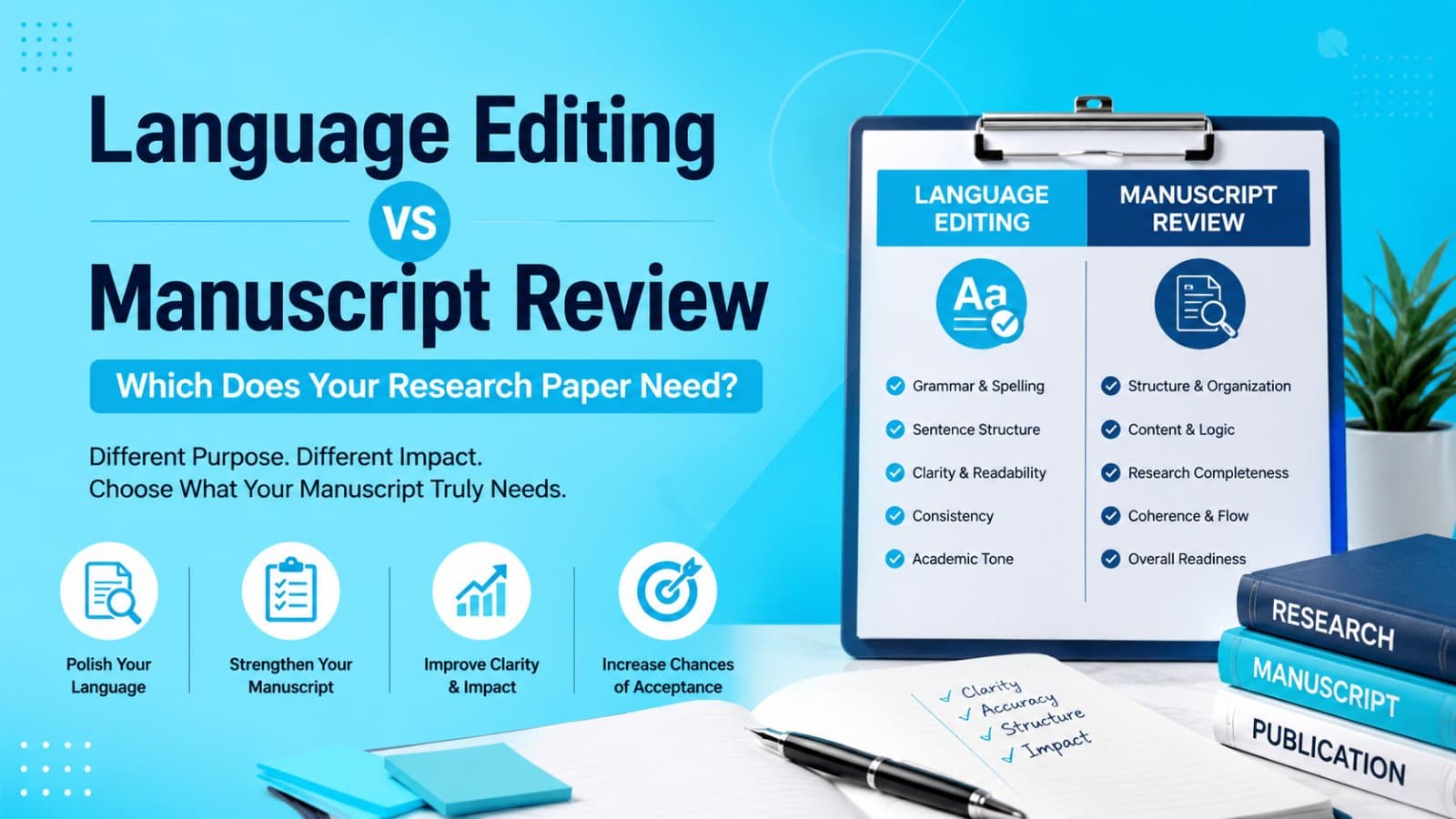
| Language Editing | Manuscript Review |
|---|---|
| Focuses mainly on language and presentation | Examines the manuscript more broadly |
| Corrects grammar and sentence construction | Identifies structural and content-level issues |
| Improves readability and academic tone | Evaluates logical flow and argument development |
| Corrects terminology and language inconsistencies | Checks whether sections work together effectively |
| Helps make writing publication-ready | Helps assess overall manuscript readiness |
Understanding this difference is important because choosing the wrong service can leave important problems unresolved.
What Does Language Editing Actually Do?
An excellent research paper should not leave the reader struggling to understand what you mean to say.
Here is when the language editing services come into play.
Language editing focuses on the written expression of your research. The goal is not to change your findings or introduce new ideas. Instead, it helps communicate your existing research more accurately and professionally.
Professional manuscript editing service may include editing on the following aspects:
- Grammatical, spelling, and punctuation issues
- Construction of sentences
- Academic vocabulary usage
- Clarity and readability
- Ambiguous expressions
- Consistency in terminology
- Verb tense and voice
- Formal academic tone
- Transitions between sentences and paragraphs
- Language consistency throughout the manuscript
The following is especially helpful for those researchers who are writing in English as a second language.
For instance, take this sentence as an example:
"Results of the study which have been obtained indicate that there is a significant relationship between the variables."
The research finding may be perfectly valid, but the sentence needs refinement.
A language editor could improve it to:
"The results show a significant relationship between the variables."
The research has not changed. The communication has. That distinction matters.
What Are Manuscript Editing Services?
Manuscript editing services generally provide professional assistance to improve the language, clarity, consistency, and presentation of a research manuscript.
Depending on the provider and level of service, editing may range from basic proofreading to more substantial academic language editing.
This is exactly why every researcher should always consider what exactly is included in the service prior to opting for it.
For instance, academic editing services can involve language polishing, formatting, checking terminological correctness, and refining your academic writing style.
In the same manner, research paper editing services implies making sure that your paper will be coherent and suitable for the target audience.
Here is the bottom line:
Editing makes your research better but does not change your research decisions.
What Is a Manuscript Review?
Now imagine that your manuscript is grammatically polished.
Every sentence reads well.
There are no obvious spelling mistakes.
But your introduction does not clearly establish the research gap. Your methodology does not fully connect with your research objectives. The discussion repeats the results instead of interpreting them. The conclusion introduces an idea that was never properly addressed.
A language editor may not necessarily evaluate all of these issues in depth.
This is where manuscript review services become relevant.
A manuscript review takes a broader look at the paper and may examine:
- Overall manuscript structure
- Research objectives and questions
- Logical flow
- Organisation of sections
- Strength of the argument
- Consistency between objectives, methods, results, and conclusions
- Clarity of interpretation
- Strength of the discussion
- Gaps or inconsistencies
- Journal-readiness
- Potential reviewer concerns
In other words, manuscript review asks a bigger question:
"Does this paper work as a complete research manuscript?"
Manuscript Language Editing vs Manuscript Review

Here is another way to think about the difference.
Suppose a researcher writes:
"The intervention improved patient outcomes."
A language editor may check whether the sentence is grammatically correct, appropriately worded, and consistent with the manuscript's terminology.
A manuscript reviewer may ask:
- What outcomes improved?
- How were they measured?
- Was the improvement statistically significant?
- Does the result support the stated objective?
- Is the interpretation justified by the data?
- Has the finding been compared with previous research?
The first process focuses on expression.
The second examines meaning, context, reasoning, and presentation.
That is why manuscript review can go beyond manuscript language editing.
When Does Your Research Paper Need Language Editing?
Language editing could be a better option when:
1. Your research is good but your language requires improvement.
You comprehend your research well but find it hard to express your ideas in proper academic language.
2. Sentences in your manuscript are long and convoluted.
Such sentences might make it hard for the reader to understand the important parts of the study.
3. You find it difficult to maintain academic style consistently throughout your writing.
This could result in an informal tone in your research.
4. There are problems with terminology in your manuscript.
For instance, you use three terms for the same concept throughout your manuscript.
5. It's time to submit the last draft.
If the structure of the manuscript is perfect, then language editing can make it perfect for submission.
In these situations, academic language editing can help to communicate your research effectively while preserving its scientific message.
When Does Your Paper Need a Manuscript Review?
A manuscript review may be more appropriate when you are unsure about the paper as a whole.
Consider it if:
You are not confident about the manuscript structure
Does the introduction lead naturally to the research question? Does the discussion logically follow the results?
You are unsure whether your argument is convincing
A fresh academic perspective can identify places where your reasoning may not be sufficiently developed.
You received reviewer comments
If reviewers repeatedly point out issues related to organisation, interpretation, or clarity of argument, simply correcting grammar may not solve the underlying problem.
You are submitting to a competitive journal
A broader review can help identify weaknesses before they become reviewer objections.
You have revised the manuscript several times
When you have worked on the same document for months, it becomes surprisingly easy to stop noticing problems.
A fresh review can provide a different perspective.
Don't Confuse Editing With Proofreading
Another common source of confusion is editing vs proofreading.
They are related, but they are not identical.
Editing involves improving the quality, clarity, structure, and flow of writing.
Proofreading is generally the final checking stage, focusing on surface-level errors such as:
- Typographical mistakes
- Spelling
- Punctuation
- Minor grammar errors
- Formatting inconsistencies
Therefore, manuscript proofreading is usually more appropriate when the manuscript is already well-written and only needs a final quality check.
Likewise, research paper proofreading can be useful immediately before submission when the researcher wants to catch small errors that may have survived multiple rounds of revision.
Proofreading cannot compensate for major structural or conceptual weaknesses.
What If Your Paper Needs Both?
This is actually quite common.
A manuscript can have two different layers of problems.
The first layer is language:
"Is the research easy to understand?"
The second is manuscript quality:
"Is the research presented logically and convincingly?"
If both areas need attention, combining services may make more sense.
For example, a researcher may first receive a manuscript review to identify structural and content-level weaknesses. After making those revisions, the paper can go through manuscript editing services for language refinement and final polishing.
This creates a more logical workflow:
Research → Manuscript Review → Author Revisions → Language Editing → Proofreading → Journal Submission
The exact process may differ depending on the manuscript and journal, but the principle remains the same: fix deeper issues before polishing surface-level language.
How to Decide Which Service Your Manuscript Needs
Before choosing a service, ask yourself five simple questions:
| Question | If your answer is "Yes" |
|---|---|
| Is my research structure already strong? | Consider language editing |
| Are grammar and academic English my main concerns? | Consider language editing |
| Am I unsure whether my argument is logically developed? | Consider manuscript review |
| Are my sections poorly connected or repetitive? | Consider manuscript review |
| Does the paper have both language and structural issues? | Consider both |
You can also ask yourself one final question:
"If someone corrected every grammar mistake in my paper today, would I still have concerns about the manuscript?"
If the answer is yes, you probably need more than proofreading or basic language editing.
Why Choosing the Right Support Matters
A well-written manuscript does not necessarily mean that it is a good one.
On the other hand, an exceptional concept can fall flat due to poor writing.
The purpose, however, is not just to enhance the language of the paper.
The purpose is to ensure that your work will be easily comprehended, assessed, and acknowledged as something worthy of your efforts.
Professional manuscript editing will improve the language and clarity of the paper, while manuscript review will give you feedback on its structure and other aspects of its presentation.
Professional manuscript editing and review services do not take away from the researcher's accountability and responsibility. They just add another level of professionalism.
Final Takeaway
So, which does your research paper need?
If your research is strong but the writing needs improvement, choose language editing.
If your writing is acceptable but you are concerned about structure, logic, argument, or overall manuscript quality, consider a manuscript review.
If both areas need work, combining the two may provide the most complete support.
After all, it is not enough for your paper to only have proper grammar; your research requires clarity, coherence, and conviction.
Sometimes, the most crucial thing you should do before handing in your paper is not to ask, "Is my English correct?"
It is asking:
"Does my manuscript communicate the value of my research as clearly as it should?"
That is where the right professional support can make a real difference.
Frequently Asked Questions (FAQs)
1. What is the difference between language editing and manuscript review?
Language editing enhances grammatical, stylistic, readability and academic features of the manuscript. Manuscript review involves an evaluation of the paper in terms of its structure, logic, arguments etc.
2. When should I order manuscript editing services?
You need our manuscript editing services if you want to improve language, sentence structures, clarity and academic style of your paper after completing your research.
3. Does manuscript review include proofreading?
No. Manuscript review is focused on evaluating the quality and structure of the paper. Proofreading, in contrast, includes checking of the manuscript for spelling and grammar mistakes.
4. Do I have to opt for an editing or proofreading service?
You have to opt for an editing service if your manuscript requires improving in language and clarity. If your manuscript is well written already, research paper proofreading will be enough.
5. Can I use both manuscript review and language editing services?
Certainly. Manuscript review can help you to detect problems with structure and content of your paper and language editing can polish your manuscript.