
How to Write a Literature Review: Step-by-Step Guide for Researchers
Think about the topic that you are researching. You conduct a search for relevant articles and realize that there are hundreds of articles already published on the issue. From one article, you move to the other, and now you have dozens of PDFs, findings, notes, and references.
How are you going to manage all these pieces of information systematically? This is when you should know what systematic literature review is.
No matter whether you are a postgraduate student, PhD scholar or a researcher in academia, the knowledge about how to do a systematic review can help you for managing existing evidence and finding research gaps.
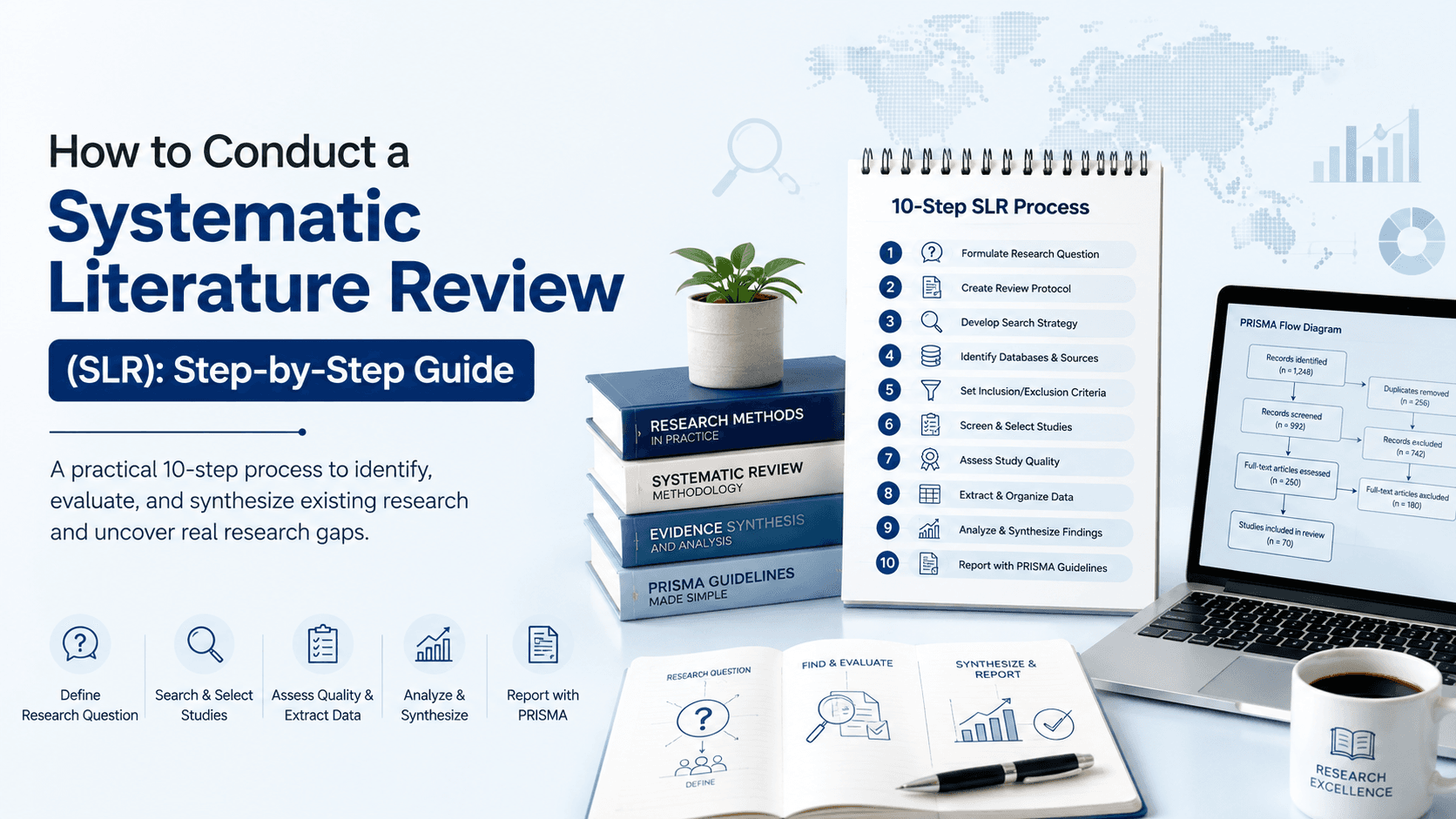
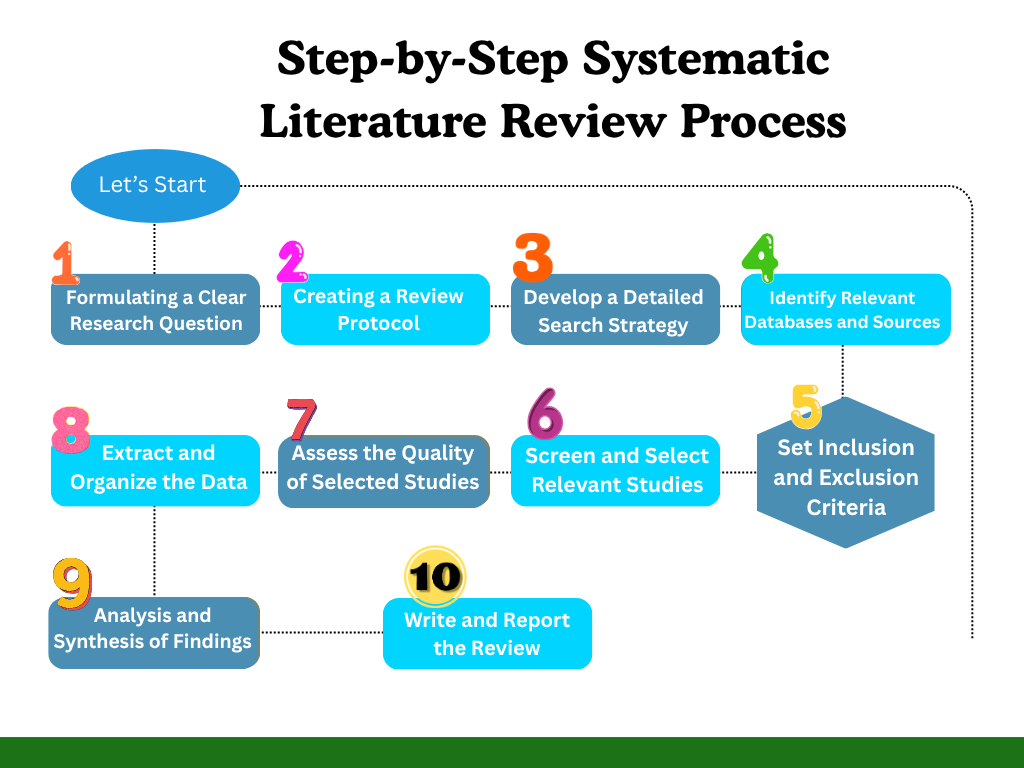
Let us go through the 10 most important systematic review steps in a simple and practical way.
What Is a Systematic Literature Review?
Before getting into the systematic review process, let's understand its definition.
A systematic review of literature is a method of research that involves identifying, selecting, assessing, and synthesizing existing literature in relation to a specific research question.
If you are asking what is SLR in research? So, in simple terms it is a planned approach to finding and analyzing existing research so that conclusions are based on a comprehensive and carefully selected collection of studies.
Unlike a literature review, a systematic review has a set protocol. It means that prior to conducting his/her research, a researcher already knows what to look for, where to look for it, which research should be used, and how to interpret the results of such a study.
Some of the questions that a systematic review answers are:
- What is already known about a research topic?
- What findings have previous studies reported?
- Where do researchers agree or disagree?
- What methods have been used?
- What research gaps still exist?
- What areas require further investigation?
So, a systematic review can be seen as an organized and valid method of interpreting available information and determining future research needs.
Step-by-Step Systematic Literature Review Process
After looking at systematic review definitions, it is now time to discuss the major systematic review steps in more detail.
Step 1: Formulating a Clear Research Question
Every proper systematic review starts from formulating a good research question. Do not formulate wide questions and define what you are looking for.
Example:
- Wide: "How does technology affect education?"
- Narrow: "How do the use of AI systems affect the academic performance of university students?"
A research question will help you identify relevant articles, search terms, databases, and research approaches to be used. It also gives guidelines about the systematic review methodology.
Step 2: Creating a Review Protocol
A review protocol can be regarded as a roadmap of your investigation. It is a kind of guide to how you will conduct your review before searching for studies.
It generally includes:
- Research objectives and questions
- Search strategy and databases
- Inclusion and exclusion criteria
- Screening process
- Quality assessment method
- Data extraction and synthesis methods
The protocol will help maintain consistency in the review process and minimize any bias that may arise.
Step 3: Develop a Detailed Search Strategy
Develop search terms based on the topic in hand.
For example:
combined with:
"Higher Education" OR University OR College
Make sure that you use Boolean operators like AND, OR, and NOT to narrow down your keywords. Make sure that you also keep note of your keywords as well as the date when you conducted your search.
Step 4: Identify Relevant Databases and Sources
Database selection should be based on your area of research and not a singular source alone.
| Research Area | Possible Databases |
|---|---|
| Medicine & Healthcare | PubMed, Scopus, Web of Science |
| Computer Science | IEEE Xplore, ACM Digital Library, Scopus |
| Education | ERIC, Scopus, Web of Science |
| Social Sciences | Scopus, Web of Science, ProQuest |
Moreover, you should consider looking into suitable databases, journals, and bibliographies.
Step 5: Set Inclusion and Exclusion Criteria
Clear selection criteria help you decide which studies belong in your review.
Inclusion criteria may include:
- Relevant to the research question
- Published within a specific period
- Uses an appropriate research design
- Meets the required population or topic criteria
Exclusion criteria may include:
- Duplicate studies
- Irrelevant research
- Studies outside the selected period
- Papers lacking sufficient information
Set these criteria before screening to keep the process consistent.
Step 6: Screen and Select Relevant Studies
The following phase will be to review the search results and find the relevant articles.
Screening typically involves:
- Database Search: Retrieve relevant articles from the selected databases
- Remove Duplicates: Look for the duplicated articles and remove them
- Title and Abstract Screening: Evaluate the title and abstract and screen out articles which are not related to the research question
- Full Article Screening: Read the entire article for the selected articles and decide whether or not they meet your inclusion criteria
- Final Study Selection: Include only the articles which meet all your inclusion criteria
It is important to note down the reasons for exclusion of the articles, especially the full text screening.
Step 7: Assess the Quality of Selected Studies
Relevant studies are not necessarily equally reliable. Assess their quality based on factors such as:
- Research design
- Sample size
- Data collection methods
- Risk of bias
- Methodological rigor
- Validity of findings
Use an appropriate critical-appraisal tool based on the type of research being assessed. This strengthens the credibility of your systematic review research.
Step 8: Extract and Organize the Data
Once the final studies are selected, collect important information from each one using a consistent extraction table.
| Information | What to Record |
|---|---|
| Author & year | Study details |
| Objective | Research purpose |
| Methodology | Research method |
| Sample | Participants/data |
| Key findings | Main results |
| Limitations | Study weaknesses |
| Research gaps | Unanswered questions |
This makes it easier to compare studies and identify common patterns.
Step 9: Analysis and Synthesis of Findings
Next, consider the studies selected for the review and analyze them in order to find patterns, differences and knowledge gaps.
Inquire:
- What are common findings?
- How do the studies differ?
- What methods are employed in the research?
- What topics have yet to be investigated?
Depending on the data provided, either narrative, thematic, qualitative, or quantitative synthesis can be performed. In case of necessity, researchers perform systematic review with meta analysis in order to statistically combine similar results.
Step 10: Report the Review Following PRISMA Guidelines
Finally, elaborate on the method used as well as the results obtained. The PRISMA checklist assists in describing the method used in selecting the articles.
The PRISMA systematic review usually includes the use of a flow diagram that shows:
Adherence to the PRISMA guidelines for systematic review increases comprehension and facilitates the evaluation of systematic reviews and even their reproducibility.
What Are the Common Mistakes to Avoid in a Systematic Literature Review?
Nevertheless, even in case the general procedure is clear to the researcher, some common errors can affect the quality and reliability of a systematic review.
Knowing them before conducting a systematic review helps you to perform your task more efficiently.
1. Beginning with a Very Broad Question
A very broad research question may lead to the appearance of thousands of articles, and, thus, you will not be able to conduct the review properly.
Solution:
- Narrow down your research question to an issue, population, intervention, or an outcome
- Use the framework like PICO or PICOS if needed
- Make your research question more specific
2. Using Only One Database
Limiting yourself to one database can lead to missing many studies that are relevant to your research.
Solution:
- Search through several databases that relate to your research field
- Experiment with various keyword combinations and synonyms
- Also think about other sources like references, repositories, and conference proceedings
3. Not Documenting the Search Strategy
Failing to record how and where you searched can make your review difficult to verify or reproduce.
Solution:
- Record the databases you searched
- Save your search strings and keywords
- Document the number of records retrieved and screened
4. Changing of Criteria during Screening
Modification of the inclusion/exclusion criteria based on the results obtained during the screening process can introduce bias in the review.
Solutions:
- Identify your criteria prior to performing the screening process
- Use the same criteria in evaluating all the studies
- Should there be any need for changes, record the reasons clearly
5. Disregard of the Quality of Studies
All published studies do not have the same degree of methodological quality. This could lead to erroneous findings if included in the review.
Solutions:
- Apply the correct tool for assessing the quality of research
- Consider problems related to the research design, methodology, sampling and vulnerability to bias
- Evaluate the study quality while analyzing and synthesizing information
Can Researchers Get Help With a Systematic Literature Review?
Carrying out a systematic review may be quite a lengthy process especially when dealing with hundreds or even thousands of research works.
For those researchers who might require help in terms of methodology and techniques, the use of systematic literature review services may be recommended in order to perform various tasks like literature search, screening, data organization, methodology, etc.
But researchers have to be sure that all the work is being done according to the proper academic and ethical standards.
Frequently Asked Questions
1. What is a systematic literature review?
Systematic review is defined as a comprehensive search, appraisal, and analysis of relevant scientific research to provide an answer to the research question at hand.
2. What are the processes that comprise systematic literature review?
There are several processes involved which include formulating the research question, searching for literature, screening, appraisal of quality, data extraction, synthesis of the results, and finally reporting the findings.
3. What are the differences between literature and systematic reviews?
While a traditional literature review is performed on a less rigorous basis, the systematic review is about performing the predefined procedures of searching, selecting, evaluating, and synthesizing the relevant scientific literature.
4. Is PRISMA necessary for conducting a systematic review?
PRISMA is a set of guidelines for reporting how a systematic review was conducted and what criteria have been applied when selecting studies.
5. Is it necessary to perform a meta-analysis within a systematic review?
Not necessarily. Meta-analysis is needed only when quantitative information gathered in studies that are sufficiently similar can be synthesized.
Final Thoughts
Systematic literature review might appear to be a difficult process at first, but the whole thing becomes more understandable once it is divided into certain phases.
It begins with defining a research question, creating a protocol, searching the necessary databases, screening, appraising studies, and synthesizing the evidence found. Systematic review does not only involve reading academic articles; it is a set of procedures used for answering a particular research question.
Having learned those above steps, you will have no trouble conducting your review.