
AI in Research Writing: Benefits, Risks, and Ethical Considerations
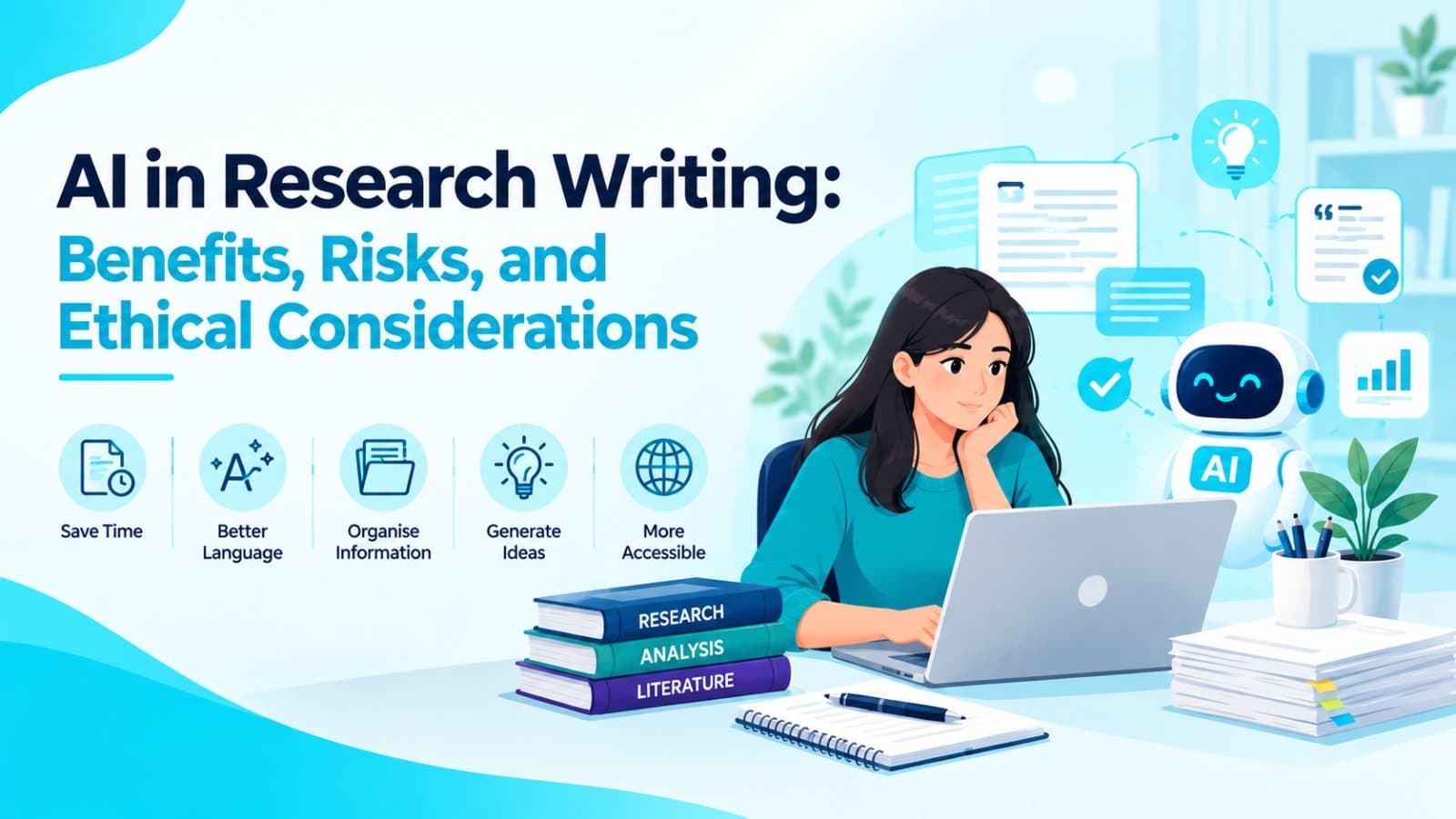
Research writing is more than simply putting words to the facts. It includes analysis, evaluation of evidence, developing arguments, interpretation of findings, and presentation of ideas. Nowadays, AI has come to be widely used for carrying out the very same task. There are several activities that AI performs in research writing that take a lot of time.
However, there are some issues to think about as a result. Can researchers take anything that AI produces for granted? Will it influence their originality? What happens if AI makes mistakes? And at what point must they stop?
These concerns make AI in research writing a matter worth exploring.
In this blog, I will look at both pros and cons of AI in research writing along with how researchers can use it in a responsible way.
What Is AI in Research Writing?
In simple terms, the application of AI in research writing entails the use of artificial intelligence in helping with various processes when writing academic or research-related material.
These include:
- Improving grammar and sentence structure
- Rephrasing unclear sentences
- Summarising research material
- Brainstorming ideas
- Creating preliminary outlines
- Identifying themes in large amounts of text
- Translating content
- Improving readability
- Organising information
This is where concepts like AI for research and AI academic writing become relevant. However, there is one vital point to keep in mind.
It should be noted that the presence of AI can assist the writing process does not mean that AI is automatically a researcher. The research article embodies the thoughts of the author, his analysis and interpretation.
There is some work done by the AI, however, the responsibility for choosing information to include in the final draft belongs to the author himself.
It is extremely important when considering the advantages and disadvantages of such technology.
Benefits of AI in Research Writing
There is a reason why there has been growing attention to AI among researchers. The appropriate use of AI could assist in eliminating redundancy, making writing easier for the researcher, and providing time for thinking.

1. Saves Researchers Time
There are numerous actions that are involved in researching writing and which may take hours to complete but will not require much analysis. With AI assistance, such actions can become easier and help make the entire process of writing faster.
A researcher is able to use AI to:
- Make grammar, spelling, and punctuation checks
- Improve the wording of sentences if required
- Summarize large portions of research material
- Develop a structure/outline
Therefore, for example, a researcher may request an AI machine to refine language without altering the meaning of the text. Moreover, a researcher will be able to review the recommendation and then make a decision about whether or not to include this information.
This way, researchers will be able to concentrate on analysis and interpretation of information.
2. Improves Language and Readability
An excellent research topic can become less significant in case it is hard to comprehend. It may also be difficult for researchers who write in a non-native language.
AI can help in improving readability in academic writing by helping researchers:
- Detect mistakes in punctuation and grammar
- Break down too complex sentences into simpler forms
- Avoid unnecessary repetition
- Offer a more concise way of stating an already stated idea
It is one of the ways in which AI in academic writing can assist, in particular when editing a manuscript.
But researchers need to go through every suggestion carefully. Even if there is better grammar, it doesn't mean there is better scientific communication.
3. Helps Organise Research Information
Researchers often work with a large amount of information, including journal articles, abstracts, notes, references, and research findings. Keeping track of everything can become challenging, particularly during a literature review.
Some AI tools for research can help researchers:
- Identify recurring themes across research material
- Summarise lengthy documents
- Organise information into relevant categories
- Highlight important concepts or relationships
It is a good starting point for researchers when there is a lot of literature to be read.
AI-generated summaries cannot replace original articles. In addition, the researchers will have to go back to the original document in order to understand the context, process, results, and limitations before using any kind of information in their research.
4. Assists in Idea Generation
Sometimes, the researcher may know all about the topic, yet may have trouble organizing the ideas. AI can play a role as a brainstorming buddy during the initial writing phase.
This can be done through AI as follows:
- Explore possible research questions
- Generate potential themes or subtopics
- Suggest possible manuscript structures
- Consider different ways to present an argument
Then, the researcher will be able to assess these recommendations and choose the ideas that work for the research.
The main thing is that AI will help in developing the thought process; however, it should not substitute the intellect of the researcher.
5. Enhances Accessibility
Language can be a significant problem in academic writing. It can help researchers present their knowledge better, especially when they have to operate in multiple languages.
With the help of AI-based writing assistance, researchers can:
- Translate research content between languages
- Simplify complex sentences without losing meaning
- Improve overall readability
- Adapt language for clearer communication
Various AI academic writing tools now provide these types of writing assistance.
Used responsibly, such tools can make research communication more accessible while keeping the researcher's ideas, evidence, and intellectual contribution at the centre.
What Are the Risks of AI in Research Writing?
The convenience of AI comes with another side.
The risks of AI in research becomes especially alarming when scientists no longer consider it just as an assistant but see it as an uncontestable source of knowledge.

A] AI Can Create Wrong Information
Texts created with the help of AI software can sound convincingly true even if this is not the case. The software can give a wrong explanation of something, distort a finding made in research, or create a scientifically looking statement which has no ground at all.
Such information cannot be trusted in the context of research writing since one expects the content to be based on evidence.
B] AI Can Generate False Citations
Imagine finding a perfectly formatted citation in your manuscript, only to discover that the paper does not exist.
This can happen with some generative AI systems.
AI may sometimes produce incorrect authors, publication details, journal names, or references that appear genuine.
For this reason, researchers should never copy AI-generated references directly into a manuscript without checking them.
A citation should lead to a real and relevant source.
C] Overdependence Can Affect Critical Thinking
Research requires curiosity and questioning.
Researchers need to ask:
- Why does this finding matter?
- Does the evidence really support this conclusion?
- Could there be another explanation?
If researchers allow AI to make too many of these decisions, they risk reducing their own involvement in the intellectual process.
The problem is not using AI.
The problem is stopping the thinking process because AI has already provided an answer.
D] AI Can Introduce Bias
These AI algorithms are trained and created based on extensive amounts of data, which might have biases.
Consequently, the AI summary or explanation created by the algorithm will carry inherent assumptions or limitations.
It is important for the researcher to critically review the AI generated output and not consider it unbiased due to the use of advanced technology.
E] Privacy and Confidentiality Might Become an Issue
Research might include some unpublished results, confidential documents, proprietary information, or sensitive participant data.
The uploading of such sensitive data to an AI system without knowing about the process of handling data might lead to privacy issues.
It is recommended that researchers review the tool and their institutional policies prior to uploading any sensitive data for research purposes.
F] AI Can Blur the Line Between Assistance and Authorship
This forms one of the major issues facing research writing about AI.
It is totally different for AI to help in correcting grammar compared to getting the entire research done by AI and passing it off as your own work.
The higher the involvement of AI in the intellectual content of the research work, the higher the issues of authorship.
Ethical Considerations of AI in Research Writing
Ethical considerations related to AI are not just about whether the researcher can use it.
They are about whether the researcher is using it ethically, responsibly, and openly.
1. Academic Integrity
Researching relies on trust.
Trust that researchers really did the work they report; analyzed data and results as they reported; and came up with conclusions based on their findings.
The use of AI itself is not necessarily against academic integrity. But when the researcher uses AI and presents the results as his own work without any intellectual engagement can raise serious integrity issues.
2. Transparency About AI Use
Researchers should understand the AI policies of their target journal, university, institution, or funding organisation.
Some publications/journals can ask researchers to disclose some types of AI usage.
Transparency in the use of AI can give an idea about how the manuscript was prepared.
3. Human Responsibility
AI systems cannot be held accountable for any errors in the published research.
If some inaccuracy is found in the statement provided by AI, the researcher cannot hide behind AI and say "It was an error of the AI."
The responsibility for the accuracy of the manuscript belongs to the researcher.
4. The Security of Research Information
The ethical use of AI will also necessitate the protection of information.
Any entry of confidential, non-published data or private information into an AI system is going to need much deliberation.
Confidentiality must always come before convenience.
5. Maintaining Originality
The importance of research is the contribution to the body of knowledge.
When an individual becomes heavily reliant on AI systems to generate content for their research, there will be a lot of questions as to whether this is an intellectual contribution at all.
Conclusion
Some elements of AI in research writing are changing into another form. It makes life easy for the researcher as it saves time and improves language, organizes data and helps in conducting repetitive tasks.
However, these benefits bring many challenges.
The accuracy of data, fraudulent references, bias, privacy issues, dependence on technology, and the originality of research are affected when using AI for academic writing.
Thus, ethical use of AI goes far beyond technical expertise. It involves ethical decision making.
It does not mean that people need to decide which one to use, AI or humans. The point is to find out how to use it in the most effective way without neglecting human intelligence, validation, and originality.
AI can make research writing more convenient. The responsibility of researchers is to make sure it does not become less reliable.
Frequently Asked Questions (FAQs)
1. What is the benefit of AI in research writing?
With the use of AI, scholars are able to save time, perfect their grammar and writing styles, organize their research data, summarize texts in bulk, and generate ideas while drafting their initial drafts. However, scholars should always edit AI drafts, and be responsible for the final draft.
2. What are the key dangers of using AI in research writing?
Inaccuracy, wrong citations, AI bias, over-reliance on technology, privacy problems, and the questions of authorship and originality are some of the key dangers that are becoming especially problematic when researchers use AI without revising the generated text.
3. Can it be unethical to use AI in research writing?
It might not even be the case. In fact, what will influence the emergence of ethical issues is how the AI is being used. What the researcher should do is remain intellectually engaged, verify the reliability of the data collected from the AI tool, keep the research data confidential and inform of the use of AI when appropriate.
4. Is the AI-generated material prepared to be used directly in the research paper?
The AI-generated material cannot be used directly in the research paper. There is a need to authenticate the information and references presented before their use. The responsibility of validating the material rests with the researcher.
5. How can the researchers use AI responsibly?
The researchers can use AI in a responsible manner when they ensure that they use AI as an aid to their thought process and do not let it replace their own thought process. The important information has to be validated and the original sources have to be referred to.